Translation & Certified Translation Services
Written translation and certified translation services, managed in one place, for organizations where getting it wrong has consequences.
Buying a translation is easy. Running a translation program is harder. Once you are moving contracts, policies, or public-facing content across languages, the question stop at what the word costs. It becomes, “What happens when the document changes six months from now? How do you prepare a certified translation when an authority requires one?
The Translation Company has worked with institutional buyers since 2005. We support translation in more than 200 languages for organizations including law firms, manufacturers, healthcare organizations, government entities and schools.
Our project management is based in the United States, and many of the linguists who work with us have done so for a decade or more. That continuity matters because the best translation programs improve over time: terminology is approved once, translation memory accumulates, reviewers stop correcting the same issue, and every new project starts with more knowledge than the last one.
Since 2005: Institutional language work · 200+ Languages: One Managed Program · 10+ years: Average translator tenure with us · ISO-Aligned: 17100 & 18587 processes
ON THIS PAGE
- How We Match the Workflow to the Document
- What We Translate
- Certified, Notarized and Apostilled Are Three Different Things
- Our AI Policy
- What Actually Happens to a Document: Our Quality Process
- Terminology and Translation Memory
- Files, Layout, and Accessibility
- What It Costs and How We Scope an Institutional Program
- Turnaround Tiers and What Rush Actually Costs
- How This Usually Starts
- Talk With Us About Your Translation Program
How We Match the Workflow to the Document
Institutional translation is rarely one kind of work.
- A law firm sends us thousands of pages of and needs everyone of them read by a person.
- A public agency needs the same communication in multiple languages and accessible formats.
- A manufacturer cares about units, callouts and page layout as about the words themselves.
We do not force all of those documents through one workflow. The first job is to:
- Understand what the content is for
- Who will rely on it
- What happens if it is wrong
- How often it changes
- What evidence of review the organization needs to keep
From there, we decide how much review each type of document actually needs. Not everything needs three people. In some instances, it does and a certification statement.
That program view is also how cost becomes more rational over time. A recurring client should not keep paying to rediscover its own language. Previously approved translations, terminology decisions and document structures should become assets. The second year of a program should cost less to run than the first and it should read more consistently.
What We Translate
Our role on this page is not to pretend that every document is the same. We route each kind of institutional content to the right specialist workflow. Typical programs include:
- Legal and regulatory content: contracts, corporate records, policies, litigation material, compliance documents, filings and supporting exhibits.
- Business and financial content: reports, governance material, internal communications, employee documentation, training, investor and stakeholder communications.
- Technical and manufacturing content: manuals, specifications, safety documentation, product information, engineering material and structured technical files.
- Health and life sciences content: clinical, medical, patient, member and regulated communications that require subject knowledge and careful review.
- Government and public-sector content: agency communications, notices, forms, public information and recurring language-access materials.
- Education and workforce content: district, university, family, student and employee communications, including documents that move through formal review or approval processes.
- Software and digital products: localization of interfaces, help content and structured files, where the text has to fit the space it lands in.
When a program spans several of these, you keep one point of contact and set of project governance. The actual work itself goes to linguists and reviewers who know the subject. The person who is excellent at a distribution agreement is not automatically the person we want translating a technical manual or patient communication.
Certified, Notarized and Apostilled Are Three Different Things
Most of the time, buyers regularly encounter the words “certified,” “notarized” and “apostilled” in the same request, even though they describe different things. Clarifying the requirement before translation begins avoids needless steps. Oftentimes, the receiving authority wants something simpler and occasionally, it wants something more. Getting this wrong from the beginning may result in a document coming back, and the deadline that made it urgent has usually passed.
We begin by asking about the receiving authority and what they actually asked from you. We would rather send you back to ask than sell you all three stamps by default.
Certified translation
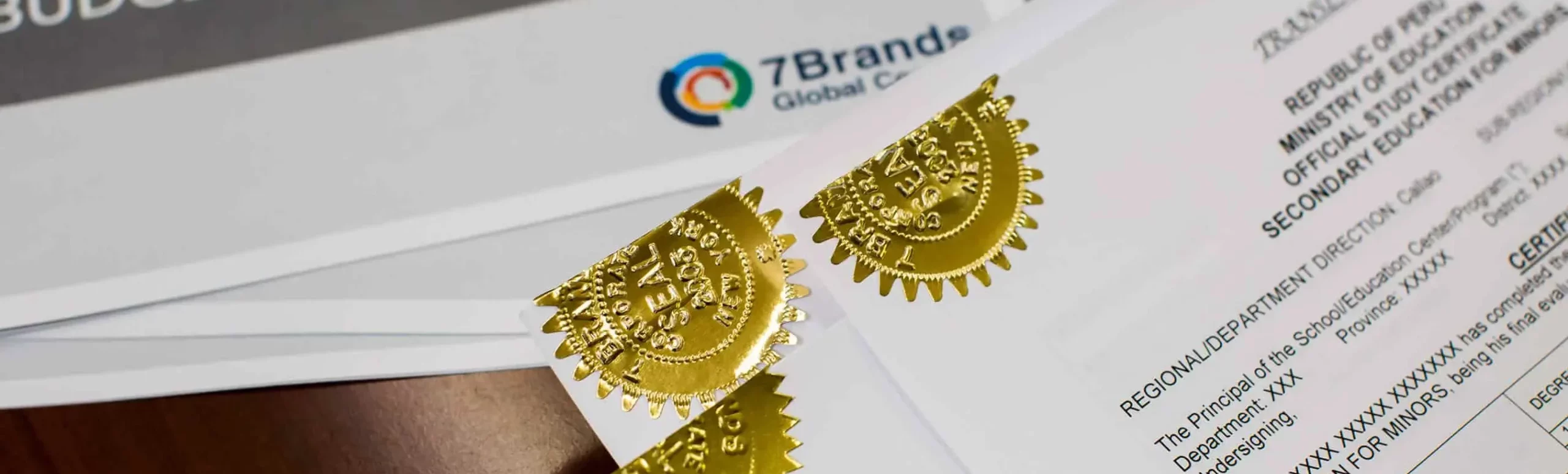
In the United States, a certified translation is generally a translation accompanied by a signed statement identifying the document and language and affirming the completeness and accuracy of the translation and the signer’s qualifications or competence. A certified translation is not the same thing as a translation performed by an ATA-certified translator. The American Translators Association certifies individual translators in specific language directions; it does not certify translation companies, and ATA certification is not available for every language combination.
Notarization
A notary does not verify the linguistic accuracy of a translation. When notarization is required, the notary typically verifies the identity and signature of the person signing the certification statement. The receiving authority determines whether that additional formality is necessary.
Apostille or authentication
An apostille is an authentication step for certain public documents used internationally. It addresses the authenticity of the underlying public document or official signature, not the quality of the translation. The correct sequence varies with the issuing jurisdiction, destination country and receiving authority.
If you need one document certified and you already know what the recipient requires, start on our Certified Translation Services page.
Our AI Policy
Technology is part of modern translation. We run modern tools the way any professional uses an instrument: with the judgment to know when they help and when they do not.
For high-stakes, public-facing, or technically sensitive material, human judgment is still essential. For large volumes of lower-risk or repetitive content, machine translation or other AI-assisted processes can be useful when they are governed correctly. Most real programs sit in between, with machine output corrected by a qualified linguist before anyone sees it.
This is our approach: we decide the workflow with you rather than hide it inside a production process.
When we use AI tools, we use professional-grade systems under policies that prohibit vendors from training on your content or keeping it for their own use. We put zero-retention terms in writing.
- For machine-translation post-editing, our process operates in alignment with ISO 18587.
- For translation service processes more broadly, we operate in alignment with ISO 17100.
We follow those standards; we do not claim ISO certification.
In healthcare, however, this is not a preference. Federal rules, (45 CFR §92.201(c)(3)), requires that machine translation of any content critical to a person’s rights, benefits or meaningful access be reviewed by a qualified human translator. If your content falls under it, the workflow is not a choice you get to make on price, and any vendor who offers you raw machine output for that material is selling you a compliance problem.
What Actually Happens to a Document: Our Quality Process
“High quality” is not a specification. You should be able to ask what happened to a document between intake and delivery and get a concrete answer. Here is ours:
For work requiring our full professional review workflow, three people touch the document.
- A qualified translator produces the target text.
- A second qualified linguist reviews it against the source – not a read-through but a comparison, segment by segment.
- Then, the project goes through final verification before delivery.
Translation, editing, proofreading.
That is what ISO 17100 describes, and it is what we operate to.
We also look beyond sentences. The sentences are rarely what fails. It is a number transposed in a table, a cross-reference pointing at the wrong section, or a heading that was never in the file the client sent us because it lived in a text box. Those are the checks that catch real problems.
The people also matter here as much as the process.
We pay translators fairly and on time. That sounds like something everyone says so here is what it looks like in practice: specialist dictionaries run several hundred dollars, sometimes over $500, so we buy them and make them available to the translators who work near our offices.
It is a benefit aimed at our supply side, not at yours. It is also why several linguists have worked with us continuously for roughly a decade or more and why continuity is something we can actually offer. Continuity gives an institution something a rotating marketplace cannot: people who remember why a term was chosen, how a reviewer prefers a recurring phrase, and which details caused trouble the last time.
Terminology and Translation Memory
Translation memory stores what has already been translated. A termbase stores the terms your reviewers have approved. On recurring material, both mean less retranslation, improved consistency, and revisions that are easier to control.
We also take a position that is less common than it should be. Ask your current vendor for your translation memory and see what happens. Plenty of them will not send it, or will send it in a format nothing else can read. It was built from your content and it should not become leverage against you. The more you translate with us, the bigger that memory gets, and it is always for you to take with you whenever you want.
If you already have translation memories, glossaries, style guides or bilingual reference material, we start from those rather than a clean slate. If they have drifted after years of decentralized translation, cleanup can be the first phase of the program before additional volume is added.
Files, Layout and Accessibility
Translation is often delivered inside a document, not as a column of words. That means the source file matters. Whenever possible, we work from editable source files so headings, tables, and cross references, can move through translation without unnecessary reconstruction.
We work in Word, Excel, PowerPoint, PDF, InDesign and structured localization files, together with multilingual desktop publishing when the translated language changes line length, direction, or typography. A right-to-left document, for example, is not finished merely because the Arabic or Hebrew text is linguistically correct; the page itself has to work in that language.
If the finished files also have to be accessible, you should inform us before we start. For example, twenty languages mean twenty accessible files, each with its own language metadata, and its own alt text written in that language. Starting from a well-structured source document is usually more reliable than translating first and then trying to repair multiple finished PDFs independently. Our Section 508 and Document Accessibility capability is built for that downstream requirement and can be coordinated with multilingual production.
What It Costs and How We Scope an Institutional Translation Program
We do not publish a rate table, but not because pricing is a secret. How translation is priced depends on a number of things:
- How much repeats
- How much review the content needs
- Whether it has to be certified
- What has to survive into the final file
The useful conversation is about the program before it is about the unit price. We normally want to understand:
- What kinds of content will move through the program, and which of them go out in public?
- Which languages recur, and which come up once?
- How often does content change?
- Who signs off on terminology inside your organization?
- What file formats, layout, accessibility or certification requirements must survive delivery?
- What security, procurement, reporting or vendor-onboarding requirements must be cleared before production begins?
We decline two kinds of work: deadlines we already know we cannot hit, and bids we can tell have gone to ten companies at once. We stopped answering those years ago, because the time costs more than the work is worth and the buyer running one is not buying what we sell. We learned this the expensive way. In our first years we took assignments from clients whose expectations we could not meet, and it went badly for both sides often enough to become policy. So we say it before the first call rather than after the first invoice.
Turnaround Tiers and What Rush Actually Costs
Most work runs on a standard schedule set by volume and language. Rush is a real service and it has a real price, because it means paying linguists to work evenings or a weekend, or splitting a document across several of them and adding a reviewer to make the seams disappear. That second cost is the one buyers do not expect: splitting a job speeds it up and makes it harder to keep consistent, so rush work needs more review, not less.
Instant document translation estimate
Ballpark in seconds, based on our published rate framework. Exact quote in about an hour.
Estimated range
Typical turnaround
Get the exact quote Human translation with second-linguist review. Repetition discounts can lower this.
Methodology: our published 2026 translation rates. Estimates are not quotes.
When it is genuinely urgent, call and say so. A person who can commit capacity will take the call.
If you need one document quickly, rush translation is the faster route than a scoping conversation.
How This Usually Starts
Many of our best institutional relationships have started simply. Santa Clara County started with a video call. After that, they sent a test assignment, then another, and it grew from there. That is how most of our long relationships have started, and it is a better way to judge a translation vendor than a capabilities deck.
A first call is usually short: what you are translating, what has been going wrong, and what has to clear before anyone can start. If it sounds like a fit, we will propose a workflow and start with a test assignment or a representative document set before anything scales.
You work with people who own the firm, not a rotating cast of junior account managers. We are a deliberately hands-on organization: 11 people work continuously with the firm, supported by roughly 30 linguists on assignment and contractor relationships. That is not a large company and we are not pretending otherwise. It does mean the person you explain the requirement to is the person responsible for getting it delivered, and that nobody is going to hand your account to someone new every six months.
Talk With Us About Your Translation Program
Send us something to translate
Not a quote request but an actual document, or a representative piece of one. We will tell you what it needs, what it will cost, and whether we are the right people for it. If we are not, we will say so.